Monitoring of bridges and viaducts
Between one inspection and the next, a bridge lives a life of its own: spans deflect, bearings and expansion joints move with temperature, heavy traffic takes its toll. Inclify measures all of it continuously — every 15 minutes by default, or more often, all year round — and warns you when the structure starts behaving differently than it should.
What slips through between inspections
A periodic inspection is a photograph. Monitoring is a film. Most of the processes that end in load capacity restrictions develop over months — and they show up in the data long before an inspector can see them.
- Span deflections — whether the structure returns to its geometry after a crossing and after the daily cycle
- Bearing and expansion joint movement — whether travel is still within range, or whether something has seized
- Temperature effects — separating normal thermal behaviour from a permanent change in the way the structure works
- Traffic overloads and vibration — the dynamic response of the structure analysed by FFT
What we measure on a bridge
Every quantity has a baseline reading, warning and alarm thresholds, and no-data supervision.
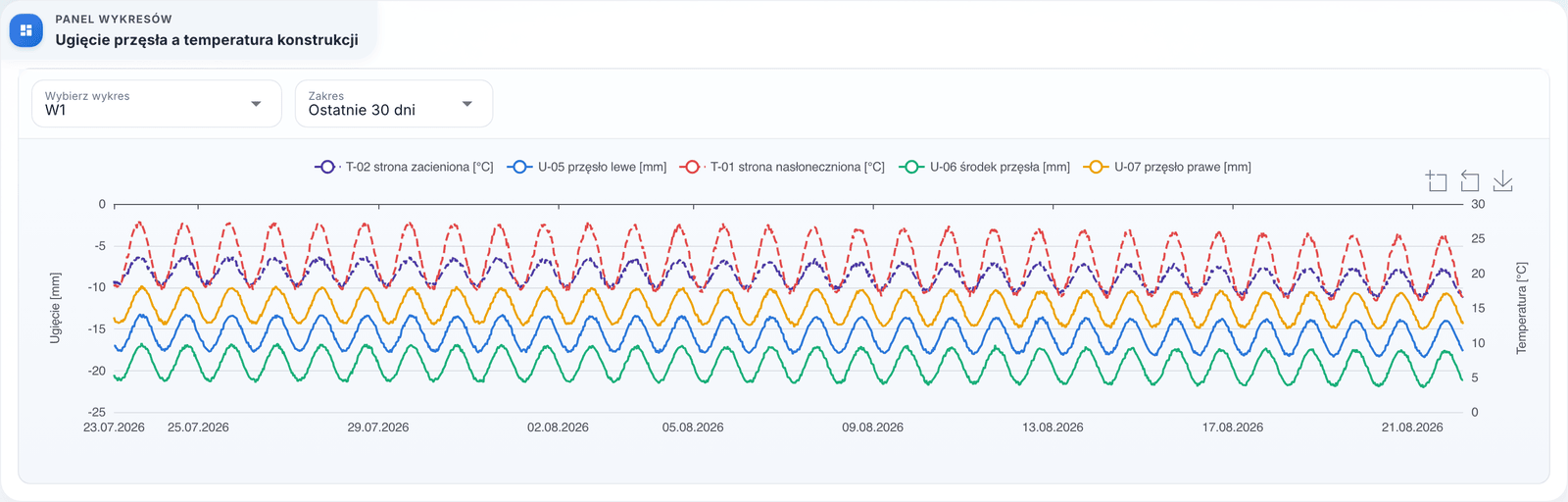
Span deflections at characteristic points — the long-term trend filtered clear of the daily and seasonal cycle.
Vibrating wire sensors on the girders and in critical cross-sections — measurement stability of 20+ years, for the whole life of the structure.
Inclinometers on piers and pylons — deviations and settlement become visible before they translate into deck geometry.
Structure temperature inside the calculation equations — so that an alarm means a real problem, not a hot afternoon.
Accelerometer waveforms analysed automatically: RMS, peak values, spectrum — with thresholds applied to the analysis results.
Already have sensors on the structure? We connect existing data loggers over REST, CSV or FTP — without replacing the hardware.
Crossing a warning or alarm threshold means an immediate notification to the people responsible for the structure.
Every operation and event is recorded: audit trail, project log, CSV/XLSX exports — a complete set for supervision and for the structure's documentation.
During service and during reconstruction
Permanent monitoring — service life
A measurement system installed for years: vibrating wire sensors with 20+ years of stability, unattended readings every 15 minutes by default, or more often, thresholds matched to the normal behaviour of the structure. The measurement history grows with the structure and becomes more valuable over time.
Temporary monitoring — repair and reconstruction
For the duration of the works: supervision of the structure while spans are jacked, bearings replaced, work is carried out at the piers, or traffic runs on a narrowed carriageway. A baseline reading before the works start, tight alarm thresholds and real-time alerts to the site manager.
Data for maintenance planning instead of inspections in the dark
Instead of deciding on a repair from a single site visit, you decide from a series of measurements computed against the baseline reading — with the full history of the changes.
- Deflection and strain trends as a hard argument when planning and prioritising repairs
- Calculation equations convert raw readings into the engineering quantities the designer works with
- CSV/XLSX exports for your own analyses and for inspection documentation
- Audit trail and project log — who changed what and when, available for every audit
Let's talk about your bridge
Describe the structure — spans, material, what worries you — and we will propose a measurement scope, sensor selection and a quote. No obligation.